Best toy boxes for toddlers UK
The best toy box for a toddler is one they can open, fill, and — this is the hard part — help to empty back into. A heavy lid, a chest that pinches fingers, or a vast ottoman that swallows every category of toy will look tidy once and then become a dumping ground. In a UK living room or bedroom, height, lid type and footprint matter more than how charming the print is on the side.
This is desk research, not a hands-on test. We compared published dimensions and features from retailer listings, and we point you to our ranked toy storage list when you are ready to choose a model. Prices change, so use the product links to check the current price. Always re-check the listing for current safety notes, weight limits and wall-fixing instructions.
Affiliate disclosure: We may earn a commission if you buy through links on this page, at no extra cost to you. As an Amazon Associate I earn from qualifying purchases. IKEA links are not affiliate links. Read our full disclosure.
What actually matters in a toddler toy box
A lid they can manage — or no lid at all. Traditional hinged lids are the usual worry on a toy chest: a falling lid can trap fingers or, in the worst case, a child leaning in. If you want a lid, look for a light lid, a soft or fabric cover, a slow-close hinge, or a chest that is sold with safety support, and read the listing carefully. Many families are better served by an open box, a fabric drawer, or lift-out bins with no heavy lid at all.
A height the child can reach. A box that sits on the floor, or a low unit under about 70–80 cm, lets a toddler put things in. Tall bookcases filled with toys just become climbing frames.
A size that does not mix everything into one heap. One huge chest is tempting. It is also how the farm animals disappear under the ride-on car. Several smaller boxes, or one box plus a low organiser with separate bins, is easier to live with. Soft toys can share a box; small parts should not.
Rounded edges, stability and a wall anchor. Check the listing for rounded corners, an anti-tip kit, and any stated standard or safety testing. We do not repeat certification claims unless they are clearly stated, and you should verify them on the current page before you buy. Fix anything climbable to the wall.
Weight when it is full. A “toy box on wheels” is only useful if you can still move it, and if it cannot roll into a doorway on its own. Look for a catch or a design that stays put when parked.
Open organisers and lift-out bins
For most toddlers, a low frame with several bins behaves better than a single chest. The child can take one bin to the rug and bring it back, which is the beginning of tidy-up.
The Amazon Basics kids toy storage organiser with 12 plastic bins is our number one toy-storage pick. It is listed at 85.3 x 27.7 x 79 cm, with a frame that anchors to the wall according to the listing. Twelve bins will be more than a toddler needs; use a few for toys and leave some empty, or use others for books and muslins if the unit stands in a living room. See our small living room guide for how this sits with sofas.
The Argos Home kids 4-tier basket unit is a similar layout at 86 x 30 x 80.5 cm, with twelve removable baskets, and it folds flat if you move house, according to Argos.
IKEA’s TROFAST combination (editorial link) is slimmer at 46 x 30 x 94 cm. The pull-out boxes are a familiar toddler-friendly idea in UK homes, and you can start with a few boxes and add more later.
These are not “toy boxes” in the chest sense, but they solve the same problem with fewer lid worries.
Low units with a toy box built in
If you want something that looks more like furniture, choose a low unit where the box is only one part of the design.
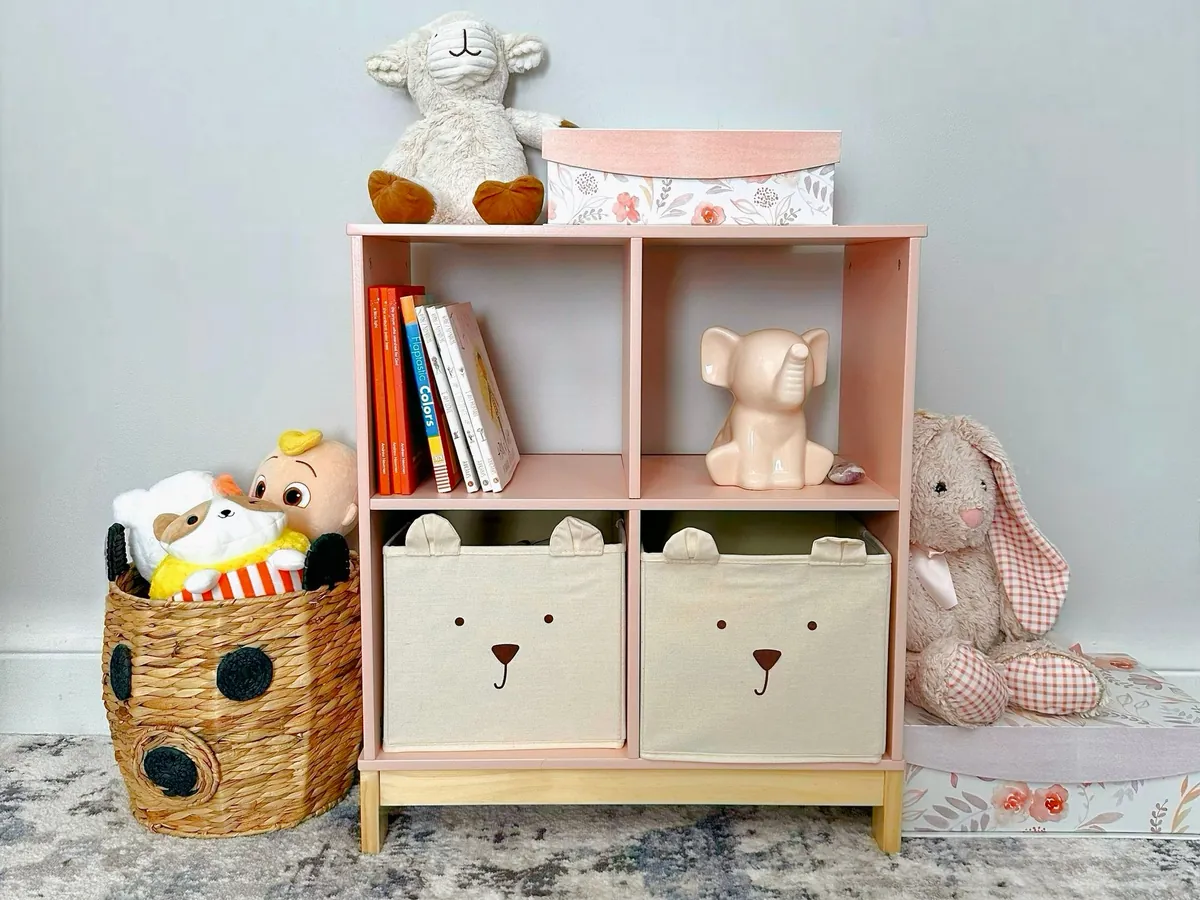
The SONGMICS children’s storage shelf with toy box on wheels is listed at 62.5 x 29.5 x 70 cm, with three open cubbies for books and a roll-out toy box underneath. The listing describes rounded corners and an anti-tip kit. The roll-out box is the toddler-friendly bit: it can come to the play mat, then go back under the shelf. Check the current listing for how the lid, if any, is designed, and fix the shelf to the wall.
The Kids Reese bookcase with toy box at Dunelm is listed at 60 x 40 x 40 cm, with book storage built into the sides and rounded edges and corners, and it is low enough for toddlers according to the product description. At 40 cm high it is a genuine sit-beside piece rather than a tall unit. The extra depth (40 cm) is worth measuring in a small room.
The Liberty House Toys unit with five fabric drawers is listed at 100 x 30 x 55 cm. Fabric drawers on board bases are light for a toddler to pull, and the top can take a couple of picture books. Wall fixings are mentioned in the listing; use them. A wide, low unit like this often fits under a window if radiators and curtains allow.
Smaller carry boxes, not one giant chest
For a first toy box in a bedroom or to sit beside the sofa, a set of smaller boxes can be kinder than one chest.
The SONGMICS set of three stackable toy boxes are listed at 38 x 35 x 25 cm each, with animal-face designs and magnetic flip lids according to the listing, and they are described as light enough for small children to carry. A magnetic fabric or light lid is a different proposition from a heavy wooden chest lid, but you should still watch fingers and check the current product page.
The Wham Crystal 25 L boxes (pack of five, 42.5 x 33 x 25.5 cm each, UK-made according to the listing) are a practical, unsentimental option. Clip lids keep things in, clear sides show what is inside, and they stack. A toddler may need help with the clips; these are excellent for a parent-managed overflow or for starting a simple rotation.
Avoid packing small parts — Lego, tiny figures, beads — into a toddler’s open box. Those need a lidded tub a parent controls. Our Lego storage guide covers that separately.
Safety checks before you click buy
Run through this on the listing and again when the box arrives:
- Can the lid slam? Is there a stay, a light fabric cover, or no lid?
- Are edges and corners described as rounded?
- Is there a wall-fixing kit, and can you actually fix it in that room?
- Is the box stable when the drawer or bin is pulled out?
- Are ventilation openings present if it is a chest a child might climb into? This is a standard concern with older-style toy chests; if the product is a sealed trunk, be cautious and read the safety section twice.
- Does the seller state a suitable age range and a weight limit?
Do not rely on a pretty photo. If the safety information is vague, pick a simple open organiser instead.
If you want to keep most toys out of sight and swap a small selection in and out, see our toy rotation storage ideas. For a ready-made bin system versus IKEA TROFAST, we compare the two in IKEA TROFAST vs a plastic-bin toy organiser.
FAQs
What is the best toy box for a toddler in the UK?
There is no single best chest. A low, wall-anchored organiser with lift-out bins, or a low bookcase with a roll-out box, is usually safer and easier to use than a large lidded trunk. Compare footprints on our toy storage shortlist.
Are toy chests with hinged lids safe?
They can be, if they have proper lid support and meet current safety expectations, but you must check the listing. Many families prefer open boxes or fabric drawers to avoid the issue altogether.
What size toy box does a toddler need?
Smaller than you think. A box or bin they can carry, plus one or two more for soft toys and books, is enough in a small room. A huge chest invites a mixed jumble.
Should a toddler toy box have wheels?
Wheels help if you want the box to travel from a shelf to the rug, as on some roll-out designs. They are a nuisance if the box rolls into a walkway. Check for a stop or park it against a wall.
Can I use stacking plastic boxes instead of a wooden toy box?
Yes. Clear clip-lid boxes are easy to label and stack, and they have no heavy falling lid. A toddler may need help with clips, so keep daily toys in an open bin and use the plastic boxes for overflow. Other gift-sized options are in our toy storage Christmas gifts.